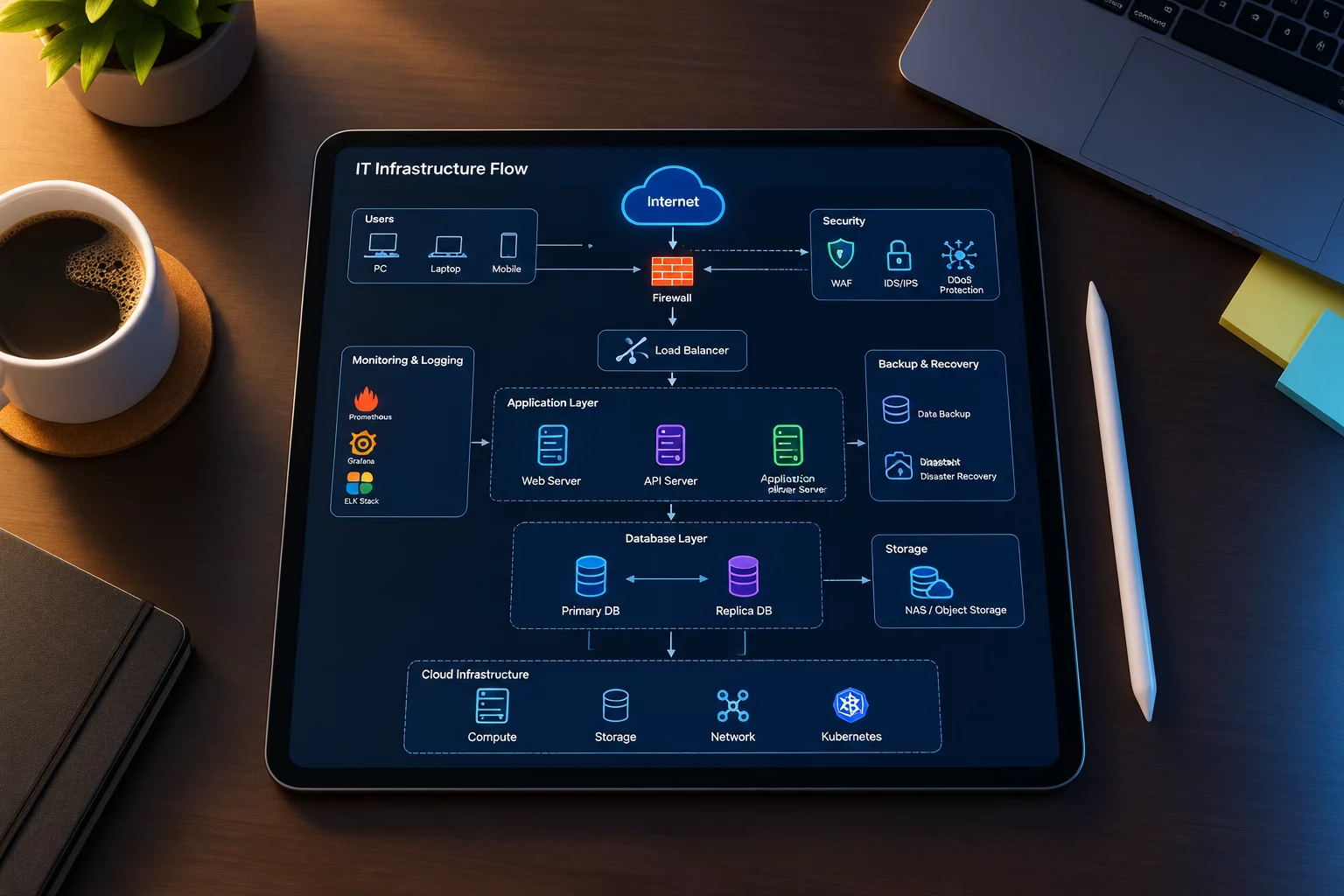
Executive Dependency Overview
Documenting the exact path to minimal operations requires mapping the underlying dependency graph rather than relying on departmental priorities. During major operational disruptions, bringing every system online at once creates massive contention, resource deadlocks, and cascading outages. Mapping the Minimum Recovery Sequence identifies the absolute baseline required to restore essential business capabilities before secondary workloads resume.
Engineering teams often assume high-priority applications should boot first. However, without underlying domain name services, storage volume locks, and authentication tokens ready, those applications crash repeatedly into boot loops. Establishing a strict minimum sequence isolates core infrastructure dependencies, preventing uncoordinated service startups.
Dependency Ordering Constraint
Never initiate application payload restoration before verifying foundational DNS, active directory controllers, and underlying SAN storage targets. Skipping validation checkpoints will trigger connection timeouts and service state corruption.
Topological Resumption Sequence
A deterministic sequence map arranges components into linear and parallel tracks based on prerequisite validation rather than arbitrary business labels. Each stage demands an explicit health check before the next tier triggers.
Foundational Identity & DNS Resolution
Restore domain controllers and internal name servers first to ensure authentication tokens and hostname resolutions function reliably across the network mesh.
Storage Target & Block Pool Mounting
Bring storage area networks and volume managers online, confirming read-write locks and file system consistency before database daemons start.
Database Layer & Message Broker Initialization
Mount database engines and transaction logs, verifying client connection listeners before web frontends or worker services attempt connections.
Once these foundational tiers pass strict validation timeouts, operational engineers can release parallel execution blocks for secondary workloads. This prevents network congestion and eliminates recursive timeout traps across dependent application clusters.
Execution Checkpoints
VERIFIED CRITERIA- Prerequisite State Core DNS & Kerberos Authentication Active
- Validation Timeout 180 Seconds Strict TCP Probe
- Fallback Protocol Isolated Maintenance State & Log Capture
- Target Resilience Tier Tier-1 Critical Baseline